
Replacement of cement with waste: acceptance of circular economy using polymer technology

When the process of recycling construction materials is approached, there are a number of obstacles to achieving a comprehensive and effective result. First, careless demolition can make the process very complex, as products with different recycling products are often mixed. In addition, not all materials can be efficiently recycled or processed, as many still need expensive or overly complex processes. But the construction industry, as a major contributor to waste production and greenhouse gas emissions, has also developed more new technologies to improve its practice. This is the case with the VOOL2LOOP project, which seeks to address one of the biggest challenges in implementing a circular approach to construction and demolition waste.
One example of unexplored possibilities of circularity is mineral wool. These are fibrous materials that are formed by spinning or extracting minerals or molten rocks, such as slag and ceramics. They act as excellent thermal and acoustic insulators, because they have an extremely low density. For the same reason, they can become a problem during demolition, because they take up significant space in landfills; they are very light but very voluminous. As mentioned in this article, “In Europe, about 2.5 million tons of mineral wool waste is generated each year during construction and demolition. Currently, mineral wool waste is almost entirely disposed of in landfills, resulting in annual costs of around € 250 million for the construction sector.
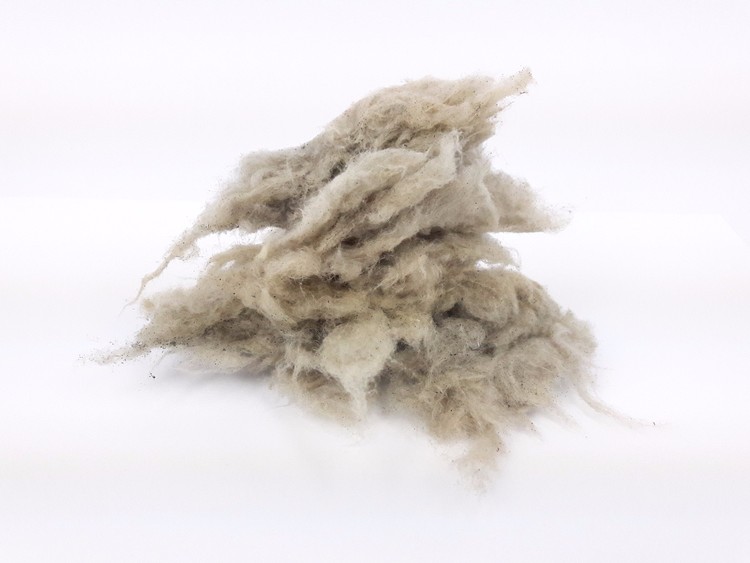
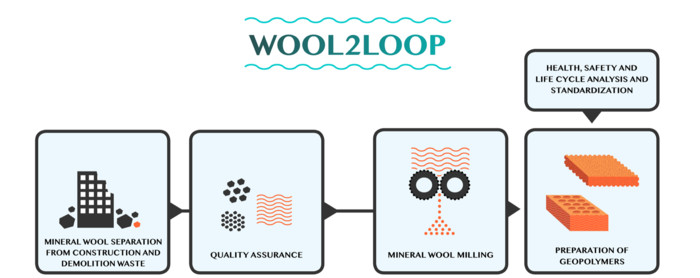
The VOOL2LOOP project aims to use mineral wool waste, after processing, in products such as facade panels, acoustic panels, paving tiles, and even as aggregates for 3D printers. To this end, a process has been developed that begins with the separation of mineral wool residues, their grinding and use as products through alkaline activation (or geopolymerization), turning them into ceramic or concrete materials. Geopolymers are considered a good alternative to traditional Portland cement (OPC), mainly due to comparable mechanical properties, while releasing some carbon dioxide. The great advantage is that several residues from existing industrial processes can be used for the production of geopolymers, such as fly ash or slag from furnaces, which makes the process ideal both ecologically and economically. To get an idea of the impact, approximately 5-10% of all man-made CO2 emissions are generated in cement production. Geopolymerization is becoming an increasingly accepted method for the preparation of low carbon dioxide binders, other products and materials from various industrial by-products, one of which is mineral wool waste.
It is estimated that geopolymer concrete made of mineral wool produces approximately 80% less CO2 emissions compared to ordinary concrete, and the final product is twice as hard as conventional high-strength concrete.
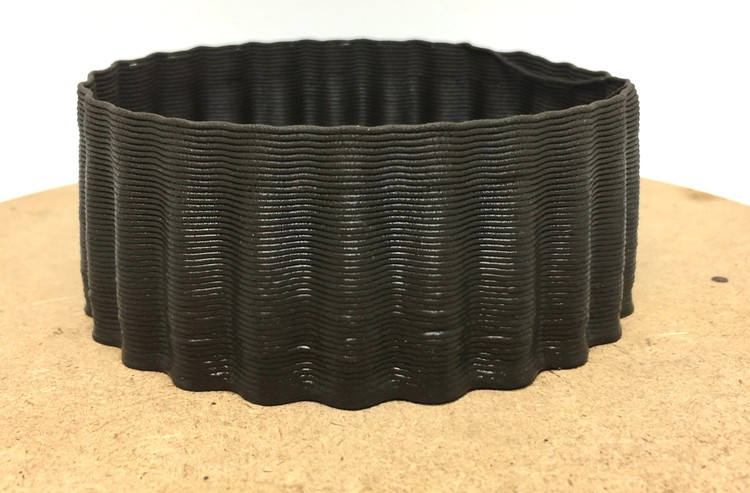
Among the various areas of the project, 3D printing is one of the most promising. Different printing possibilities of different geopolymer mixtures containing insulating materials extracted from the construction site are currently being tested. With proper mixing relationships and customization of printing technology, new geometries can be created that would not otherwise be possible with traditional techniques.
VOOL2LOOP has developed a consortium of 15 partners, with companies including Saint-Gobain Finland, NGOs and research institutions. As Anne Kaiser, Sustainability Manager at Saint-Gobain Finland, points out, “By turning mineral wool into a raw material for new products at the end of its life, we become part of new industrial ecosystems and promote eco-innovation in the circular economy. demolition ”.
Find out more about the VOOL2LOOP project on the official website.